Episode Transcript
SEASON 1 EPISODE 4
How We Lost Trust In the News, So Now What?
[Clip: Title Sequence]
(plays)
[Clip: Walter Cronkite – “And that’s the way it is” (The Most Trusted Man in America)]
(plays)
LISA: It’s not the best of times, nor the worst, but these are undoubtedly independent times. Welcome to Independent Times, the podcast for politically homeless independent voters navigating our polarized world. I’m your host, Lisa Singer, and I’m so grateful you could join us today.
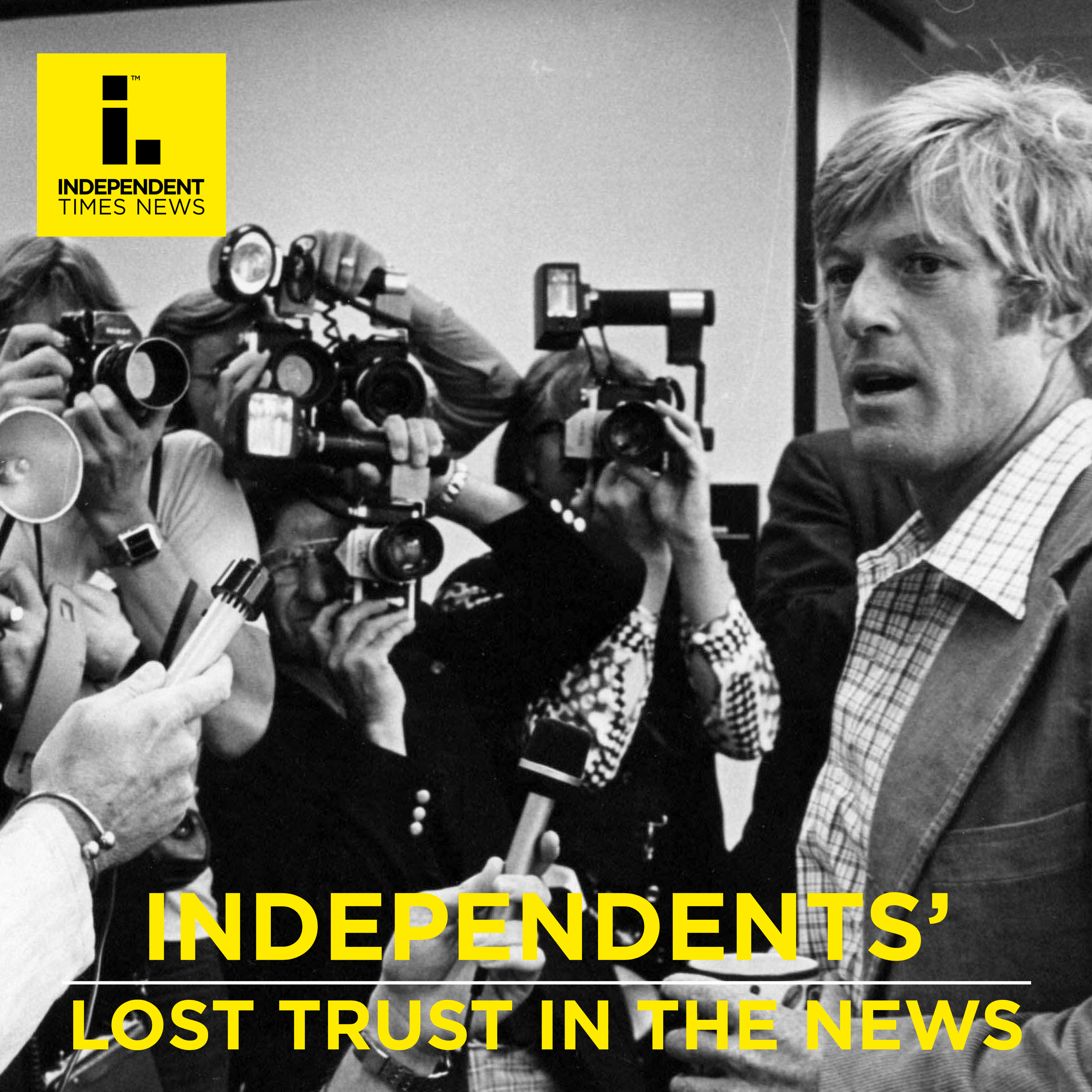
We are consuming more media today than ever before in history. Yet we are more polarized and feel less informed than ever. Remember when the news felt different? When were figures like Walter Cronkite the most trusted in America? Today, it's an endless cycle of partisan outrage, and it's easy to feel like you want to tune it all out.
Well, you’re not alone. A 2025 YouGov poll shows just 29% of independents trust the media. And for independent voters, that's not just a number—it’s a serious problem, leaving us to ask, "If I can't trust the news, how am I supposed to feel safe, much less be expected to vote?" Today, we’ll dive into the critical moments that took the press from a unifying force to a polarizing one. We'll lay out the story of what went wrong, not to dwell on the past, but because you can't fix a problem you don't understand. More importantly, we’ll share practical tools to help you navigate the news with confidence and healthy skepticism. We’re joined today by my co-hosts: award-winning journalist, host, and producer of FOX24 News Now, Leyla Gullen, and Emmy award-winning television news host Bryan Gallo. Welcome.
BRYAN: Thanks, Lisa. Independents are caught in the crossfire, trying to find truth in a sea of spin.
LEYLA: Absolutely. Trust has fallen from 72% in 1976 to 31% in 2024, according to Gallup.5 This didn’t happen overnight.
LISA: Agreed, it didn’t happen overnight, and we’re going to get into all of that. But I think we can agree that, despite the mistakes the free press has had an incredibly successful run that shaped our democracy for the better. Here’s a quick reminder of some of those proudest moments that made the press the indispensable Fourth Estate.
[Clip: “Why a Free and Independent Press Is Essential to Democracy”]
(plays)
LISA: That clip from Bob Scheffer nails it. A free press is our vital second source for checking the government's narrative and holding power accountable. Forget weather, sports, or traffic updates; we're talking about keeping our government from running wild. The First Amendment, written by James Madison in 1791, was a radical idea that a free press would be an essential check on power. Genius.
BRYAN: Right. And that independent spirit, no pun intended, has carried on for what, 249 years? Fast forward to 1971, and the Pentagon Papers were a game-changer. Daniel Ellsberg leaked classified documents showing US leaders had misled the public about the Vietnam War for decades. The New York Times began publishing, but the Nixon administration sued, citing national security. The Supreme Court ruled six to three for the press, with Justice Hugo Black writing, in his opinion, that the founding fathers gave the free press the protection it must have to fulfill its essential role in our democracy, end quote.
The Washington Post jumped on it and also started publishing the Pentagon Papers, which fueled anti-war sentiment by exposing government deception about the Vietnam War, contributing to public pressure for US withdrawal. That was a proud day for journalists.
LISA: Obviously, one of the greatest lessons from the Pentagon Papers is the vital importance of a strong and independent press. With only 16% of Americans subscribing to a newspaper, our support for the Fourth Estate is more critical than ever. Also, to see this dramatic story unfold on screen, check out the 2017 film, The Post. Starring Meryl Streep and Tom Hanks, it offers a gripping look at the Washington Post's courageous choice to publish the papers in 1971. For a firsthand account, you can also watch a 1997 interview where Chris Wallace sat down with then-publisher Katharine Graham. She describes the heart-pounding choice to risk everything to publish the truth. Here’s a short clip:
[Clip: “Katharine Graham on the Night They Decided to Publish the Pentagon Papers”]
(plays)
LISA: But as inspiring as that moment was—with the press standing up to power no matter the cost, it also highlights the constant tension between the White House and the media. We see it today in clashes like the Trump administration blocking Associated Press reporters from the Oval Office, or filing lawsuits against major networks for critical reporting. This presidential pushback has ramped up lately, and it's happening at the worst possible time when trust in the news has plummeted, from 72% in 1976 to a mere 31% today. It begs the question: What shifted from Watergate's triumphs to this? Did journalists drop the ball, or is something bigger eroding that trust? This is a massive issue for our democracy—and for independents who have to sift through so much spin to make informed votes. Bryan, whatever happened to unbiased gold standards like Walter Cronkite, the most trusted man in America?
BRYAN: The most significant blow to fair and balanced reporting was the ending of the Fairness Doctrine. Reagan and his supporters at the Federal Communications Commission argued that the doctrine amounted to censorship. So, in 1987, the FCC voted to repeal it. Reagan then vetoed a bill from Congress that would have made the doctrine a permanent law, officially killing it. This action, in effect, cleared the way for the partisan media landscape we know today.
LISA: Let’s look at the key moments when the Fairness Doctrine died and the door swung wide open for opinion-driven cable news and talk radio.
[Clip: “The Fairness Doctrine – How Its 1987 Repeal Unleashed Partisan Media”]
(plays)
LEYLA: You know, there’s more to the story, as we say in the newspaper business. The birth of cable news and the 24-hour news cycle was born with CNN’s 1991 Gulf War coverage and O.J. Simpson’s trial, which was covered day and night for months. News changed from informing the public to entertaining the public.
BRYAN: Well, you know the bigger story, not that those aren’t important, is the big mistakes the media made. And like everything else in life, people remember the things you did wrong rather than the things you did right.
LISA: Totally, Benjamin Franklin once said, “It takes many good deeds to build a good reputation, and only one bad one to lose it." Sorry, continue.
BRYAN: No, no, you’re good and you’re right. That’s exactly right, but honestly, the media can’t afford to make mistakes. Let me drive this home with a key recent example, bear with me. The 9/11 attacks hit on September 11, 2001, and less than a month later, on October 7, 2001, the U.S. invaded Afghanistan to take out al-Qaeda, the group behind hijacking four planes on that horrible, terrifying, deadly day.
But President Bush also wanted to invade Iraq, and the White House pushed hard to claim their leader, Saddam Hussein, had weapons of mass destruction, like chemical, biological, and even nuclear. But it was a hard case for Bush to make since Iraq was not directly involved in the 9/11 terrorist attack. Then, around 2001-2002, The New York Times, mostly from their reporter Judith Miller, ran stories amplifying these unverified claims of WMDs, relying on anonymous sources like Iraqi defectors who later proved unreliable. They didn’t dig deep enough, and neither did much of the mainstream media. Some outlets raised doubts about Iraq possessing weapons of mass destruction, but the drumbeat for war was loud. The Times admitted its mistakes, but the damage was done. It sparked a 20-year war, massive instability in the Middle East, and a huge blow to trust in the media. Independents, and quite frankly, all Americans felt betrayed, wondering why the press didn’t push harder for the truth.
LISA: Here’s Judith Miller years later, interviewed by Jon Stewart on the Daily Show, reflecting on those front-page stories and what went wrong.
[Clip: “Judith Miller and the New York Times’ Flawed WMD Reporting That Helped Launch the Iraq War]
LEYLA: True. Let me add a couple more media failures that hit the country hard. In 2008, the financial crisis blindsided Americans because most news outlets missed the signs of the housing bubble's instability. While a few reporters raised red flags, the mainstream media didn’t dig into the risks of subprime mortgages, leaving the public shocked when the market crashed and cost millions of people their homes.
LISA: Little by little, these media mistakes make it hard for Americans, especially independents, to trust the media. And it often feels like legacy media outlets are pushing a narrative rather than just reporting the facts, as they're supposed to. Margaret Sullivan, in her book Newsroom Confidential, really nails this issue. Bryan, you've also read Newsroom Confidential. What does she say about narratives taking over?
BRYAN: Well, Margaret Sullivan, a little bit of backstory, who was the public editor at the New York Times, argues that journalism has shifted toward what she calls defensive performative neutrality. This is where outlets go to great lengths to appear balanced, even if it means equating facts with fiction, right? She gives examples like some say the earth is round, others insist it's flat, or, more relevantly, some say climate change is real and caused by human behavior. Others insist it doesn't exist at all. This practice of false balance gives equal weight to both sides, but pushes narratives over truth. Does that make sense?
LISA: It does, and I love how there are flat-earth believers and support groups around the world. But there's more of a real-world implication for both sides of a new story.
BRYAN: Mm hmm. No, you're right. Mean, Margaret Sullivan's critique of the New York Times' 2016 election coverage is the prime example. On one hand, the paper ran 10 front page stories about Hillary Clinton's emails, and just like what six days, but on the other hand, the paper ran the same number of front page stories, 10 total, on all the policy issues combined in the two months leading up to the election.
So this gave readers a completely skewed perspective, prioritizing one single issue over all of the others. Sullivan believes it influenced the outcome of the 2016 election.
LISA: Here’s just a taste of how relentless that email coverage actually was from Margaret Sullivan herself…
[Clip: “Margaret Sullivan on The Media’s Obsessive 2016 Coverage of Hillary Clinton’s Emails”]
(plays)
LEYLA: To highlight, the Clinton email story is a perfect example for independents of how skewed coverage feels like a narrative is being pushed, and it fuels the feeling that the media is playing politics instead of just reporting the facts to hold power accountable, as they said in the TV show Dragnet, Just the facts, ma’am, only the facts.
[Clip: “Dragnet Iconic Scene, Just the facts ma’am”]
(plays)
LISA: Great show. So let’s stay on this point of the lack of trust in the news. Bryan, any other big stories from the past 10 years where the media got it wrong, hitting independents’ faith in journalism?
BRYAN: Top of mind is Bob Woodward’s 2020 book Rage. He had tapes of Trump admitting in February that COVID was deadly, but held the story until September, raising questions about prioritizing book sales over public health. Also, The New York Times’ 2018 Caliphate podcast was retracted in 2020 when its primary source was exposed as a fraud. And the biggest recent story is Fox News’ amplifying false 2020 election claims, which cost them
$787 million in a 2023 lawsuit from Dominion Voting Systems.
LISA: Here’s a look at how Fox anchors learned just how expensive those lies became.
[Clip: “Fox News and the $787 Million Dominion Settlement Over 2020 Election Lies”]
(plays)
LEYLA: When these kinds of mistakes happen, the retractions are often small, but the impact is massive. The impact of media mistakes is massive. I would argue it’s because we are used to politicians lying to us, but we are not accustomed to the press doing the same or falling on the job, so to speak. And in each instance of a government cover-up that drags on for years, like the Clinton-Lewinsky scandal, or the Iran-Contra affair, or the question of how involved Russia was in interfering in the 2016 election, we have to ask: Where was the fourth estate? And I know this conversation is only the tip of the iceberg, but just from a top-level perspective, how do these mistakes keep happening?
LISA: Leyla, you've worked as a professional journalist for many years, so I'm curious what you think.
LEYLA: I can only offer you a technical answer to your question. These failures violate the code of ethics that journalists must adhere to. Many belong to the Society of Professional Journalists, and their code of ethics requires journalists to seek truth, minimize harm, and act independently. This means journalists cannot accept bribes or anything like that to publish a story or push a narrative. But as a professional journalist, it is painful for me to discuss these failures and the erosion of trust in the news. It shouldn’t happen. The safeguards are in place.
LISA: Still, anyone with a laptop or cell phone can post anything they want to Social media, which is only making this worse. Bryan, is that a fair statement?
BRYAN: To some degree, yes. Social media has gutted journalism’s business model. Platforms like Facebook and Google take over 50% of digital ad revenue, starving newsrooms. Algorithms push sensationalism like fake COVID cures, and election fraud claims go viral. News consumption dropped from 51% in 2016 to 38% in 2022 as people tuned out. Independents face conflicting takes, retreat into echo chambers, or give up.
LEYLA: Social Media is killing local news. The 2024 Medill Report says 3,200+ newspapers vanished in America since 2005, with 130 closing last year, leaving 206 counties and 55 million Americans in news deserts where there is no local newspaper, not even a weekly. Here’s the scariest statistic: 1 to 2 newspapers in America go out of business every week.
LISA: Well, our founding fathers knew that the only way to keep a democracy is to have a well-informed citizenry. So this has become a crisis in our country. With only 16% of Americans subscribing to news in either digital or print form, it is a wonder any newspaper can stay in business. Is there any hope? What’s the fix? Leyla?
LEYLA: Subscribe to credible outlets, support your local newspapers, and subscribe to at least one national paper in either print or digital form. Only 14% of the world’s population has access to a free press, and ours is a privilege. Subscribing is a civic act we must all perform.
LISA: Bryan, your fix to address the lack of trust in the news?
BRYAN: Like Leyla said, everyone in America should subscribe to at least one media outlet, even if it's $1 a week, to help journalism succeed. We need them to keep us informed about the weather, sports, and local events in our communities, and, yes, of course, to hold our elected officials accountable. What is your advice, Lisa?
LISA: Like many of our listeners, I grew up in a home where the kitchen radio was constantly tuned into the news, local newspapers were delivered daily, and I have been subscribing to a national newspaper since I was 18. So, as I read social media, I can spot fake news, at least enough to check and do some more research when something looks off. So, for our listeners, I would say go to Ad Fontes Media and check the news sources you read now for their bias leaning to ensure you are getting a diverse set of perspectives for your existing subscriptions. Other places to cross-check stories are ProPublica, Reuters, AP, or Ground, which shows headline stories from the left, center, and right so you can see how a story is covered from all angles in polarized media. Independents can lead by diversifying sources.
BRYAN: Lisa, there you go again. Honestly, most of us don’t have time to cross-check the news; we just want to consume the news, not turn it into a homework assignment each day. You know what I mean. I mean, I say that with love.
LISA: Thank you. I appreciate that, and I hear you loud and clear, but sadly, that's where we are in America today, with so much misinformation, disinformation, and foreign influence. We really have no choice but to devote a little bit more time to news analysis on our own. But Luckily, it doesn’t have to be overwhelming here is a montage I put together of a few simple news-literacy habits that I hope can help our listeners.
[Clip: “Simple News Literacy Tips Every Independent Voter Can Use Today]
(plays)
LISA: Thank you, Brian and Leila.
BRYAN: Keep digging for the truth, Lisa.
LEYLA: Thanks. Question everything!
LISA: We started this episode asking how we can find clarity in a world of partisan spin. And while we went on a journey through some of the biggest mistakes in media history, we also found the answers. The tools for navigating this world are in our hands. It's about recognizing the narratives, diversifying our sources, and yes, investing in a free and independent press. And that brings us to our Independent Hero of the Week: Alan Miller, founder of the News Literacy Project, a nonpartisan nonprofit empowering students to spot fact from fiction in today's info chaos. For independents battling biased spin, his work reminds us that news savvy starts young. You can learn more about them at newslit.org. Here’s Alan in his own words:
[Clip: “Alan Miller, Founder of the News Literacy Project – Our Independent Hero of the Week”]
(plays)
LISA: What a fantastic discussion today! Thank you, Bryan and Leyla. And a big thanks to our listeners for joining our community at Independent Times, where politically homeless voters like you find clarity in a polarized world. You’re not alone in this journey.
Next time, we’ll tackle another big issue: why trust in government is at historic lows. You won’t want to miss it. Until then, please follow, like, subscribe, share, and keep charting your own path.