Episode Transcript
SEASON 1 EPISODE 5
Why We Don’t Trust Government And How To Fix It
[Clip: “Title Sequence”
(plays)
[Clip: All in the Family – Archie Bunker Debates Politics”]
(plays)
LISA: It’s not the best of times, nor the worst, but these are undoubtedly independent times. Welcome to Independent Times, the podcast for politically homeless independent voters navigating our polarized world. I’m your host, LISA Singer, and I’m so grateful you could join us today.
Churchill's famous quote, "Democracy is the worst form of Government except for all the rest," is a cynical yet profound defense of democracy. But was he right?
Churchill understood that democracy is a messy, slow, and often frustrating process, filled with endless debates, political compromises, and, at times, disappointing politicians.
We see this firsthand in our own country, where trust in government is at historic lows. For instance, a 2025 Pew Research study found that 65% of young Americans are so disillusioned that they are open to radical change. This alarmingly low trust isn't just about corruption or broken promises, but also a growing feeling that politicians prioritize their own enrichment and the interests of elites, over the public good.
So, where do we go from here? Today, we'll bridge the gap between our widespread distrust in government and its essential function. We will do this by examining the distinct roles both major political parties believe the government should play in our lives. By clarifying their core intentions, you can tune out most of the noisy political rhetoric and focus on the proposals for the issues you care about most.
While the politics of our nation is indeed messy, Churchill was right: democracy, with all its flaws, is still the best we have.
We’re joined today by my cohosts: award-winning journalist, host, and producer of FOX24 News Now, LEYLA Gullen, and Emmy award-winning television news host BRYAN Gallo. Welcome.
BRYAN: Thanks, LISA. This is a crucial topic because independents don’t just distrust the media; they’ve lost faith in the very institutions that are supposed to serve them, with profound consequences.
LEYLA: Exactly. And you can’t talk about a loss of trust until you first understand what kind of government we have and what it's even supposed to be doing.
LISA: Thank you both so much. Before we begin our discussion on our low trust in government, let’s start with a quick reality check: out of 193 countries in the UN, and for most people on earth, the options boil down to three buckets of the type of country you get to live in: democracy, theocracy, or some flavor of dictatorship. Real, functioning democracy? That’s the rarest one by far. Here’s a short video from the United Nations reminding us why democracy is worth fighting for…
[Clip: “United Nations on Why Democracy Matters: Protecting Rights and Voice”]
(plays)
LISA: Okay, before we get into the discussion, let’s make sure everyone’s on the same page. The U.S. technically invented a new type of government around 250 years ago. We are what's called a constitutional federal republic. Basically, our Constitution sets up a government with checks and balances, a federal system to handle big national tasks, and elected representatives to serve us.
BRYAN: Okay, I understand all of that. But if we're technically a constitutional federal republic, why are we always called a democracy?
LISA: America is a constitutional democracy, thanks to the Bill of Rights, especially the First Amendment, which guarantees our voice in government through free speech, assembly, and the press. And we've expanded that power over time with the 15th, 19th, and 26th Amendments, securing voting rights for more of us. Democracy means "power to the people," and here, that's "We the People" holding our leaders accountable through votes, petitions, and peaceful protests. The President, Senators, and Congress need constant reminders: they're public servants, working for us. Here's how President Obama explained it
[Clip: “Barack Obama “How To Be of Service as President…”]
(plays)
LEYLA: Well, I think one of the issues, LISA, is that a lot of Americans have forgotten just how precious and rare America and democracy are in the world today. Some of these recent protests have been pretty scary to watch. And I saw this wild YouTube debate on Jubilee show called Surrounded, where journalist Mehdi Hassan faced 20 far-right conservatives. And one guy, Conor, thinks, straight up just said he'd pick fascism over democracy and even praised a Nazi theorist, if you can believe it. It's a wakeup call. It's a wakeup call. Some folks are ready just to give up our freedoms.
BRYAN: You know, I don't think Connor really understands what fascism looks like or what life is like outside a full democracy. And let's be honest, it isn't pretty.
LISA: So let's pull on that thread a bit more. The governor of Maryland, Wes Moore, I heard him once say to Oprah, what you appreciate appreciates. So let's give some perspective to appreciate why our democratic systems matter. Let's go ahead and zoom out globally. Our founding fathers dreamed of a government of the people, by the people, for the people, but globally, that's very rare.
LEYLA: yeah, very rare indeed. Out of 193 countries that are members of the United Nations, only about 26 26 are full democracies with fundamental freedoms like free speech, fair elections, and an independent press to hold elected officials accountable. Compare that to places like Russia, where protesting or criticizing Putin can mean jail, or China, where the internet is completely censored, or how about North Korea, where you have virtually no individual freedoms whatsoever and can't even leave the country.
BRYAN: I try not to even think about what life is like outside of democracies. I will never take my freedom for granted, even with the mistakes and flaws in this country. The thought of not having the First Amendment, the right to vote, or say in how we are governed is crippling to even think about. The idea of living in a theocracy or under communism, where you are told how to live your life, feels like a prison to me.
LEYLA: But get this, only 8 % of the world's 8 billion people live in a fully democratic system. know, about 59 have flawed democracies with some elections or press freedom, but often riddled with corruption or questionable votes and the rest are authoritarian regimes or monarchies or theocracies with little to no voice for the people. We're in a really small club and you know what? It's pretty fragile.
LISA: Here's another way to think about it. In 2016, I remember what Thomas Freeman wrote in the New York Times opinion article. He was quoting a friend of his who said, you Americans kick around your country like it's a football, but it's not a football. It's a Fabergé egg and you can break it.
LEYLA: It is really profound. Yeah, I hope that the independents are the ones keeping this experiment alive and bringing this country together. Yeah, let's not break it. Let's not break it.
LISA: Agreed. And that's why independents matter so much. They're not just politically homeless. They're the ones, in my opinion, who hold the key to our future.
BRYAN: I do think we should discuss how we even got here, like how there's so much polarization and low trust in government. just, it feels hopeless now. I know sometimes I feel hopeless.
LISA: I try not to feel hopeless, but I do understand why 89 million Americans didn't show up to vote in 2024. I do understand why trust in government is at 22%.
I do understand why trust in the media is at 31%.
But the bottom line is, I think we all can agree, those are not healthy numbers.
LEYLA: No, no, they're not. Well, polarization is at record highs now in the country. And I remember in our first episode, LISA, we had showed a clip of Andrew Yang, the founder of the Forward Party, saying that we are at civil war levels of division. So that's pretty frightening.
LISA: It can be, but in some weird way, I could say the good news is that there has always been intense fighting and polarization between the parties. And we survived it. We survived it for 250 years.
BRYAN: well, it doesn't make me feel any better. Let's put it that way.
LISA: I totally get why that doesn’t make you feel better; that fear is real, and it comes straight from the system of accountability.
BRYAN: The system of accountability is broken, and that’s why people are feeling so hopeless and checking out.
LISA: I totally get why so many people feel hopeless and want to check out. When you’re part of the 60% of Americans living paycheck to paycheck, every day is a fight. You’re not lazy—you’re drowning. Credit card delinquencies are spiking, family farms are going bankrupt at double last year’s rate, mortgage late payments are surging, and seven in ten people are skipping meals just to get by. These aren’t statistics; these are our neighbors. Let’s hear from our fellow Americans in their own words.
[Clip: “Everyday Americans are Struggling”]
(plays)
LISA: History is screaming with warnings that when citizens can't breathe under economic strangulation, trust in democracy shatters and the door swings wide open to strongmen to make big promises that they alone can’t fix our woes. Look at Iran in 1979, Hungary's Orbán, Greece in the 2010s, and Russia today. All of these were once full democracies, but they are now barely democracies, if at all. This shift was ushered in when citizens, desperate for change due to an economic crisis, surrendered their freedoms. Suffice to say we’re not immune. So, who has the answer? Democrats say the government can help level the playing field with big corporations, while Republicans say we should let the free markets sort it out. I think our next step in this discussion and the way to figure out the path forward is to dig into our own American history as our guide.
LEYLA: Yeah but LISA, it's worth noting that America has had brief, shining moments of high patriotism and trust in its government, especially after facing a common enemy. The first came after the War of 1812. Our victory against the British gave rise to the "Era of Good Feelings," a period of great national pride and political unity. And later, after the Civil War, a feeling of national purpose came from the idea of rebuilding the Union and expanding westward. These moments were powerful but short-lived.
BRYAN: And that’s the key difference. In the 20th century, we had a period of high trust that was much more sustained. For decades after World War II, trust in the government was high, peaking at around 80% in the early 1960s. The reasons for this were simple. There was a unified sense of national purpose and triumph after winning the war. We had a booming economy with a growing middle class, and the government was seen as a force for positive change. It was a time of bipartisan consensus on major projects such as the Interstate Highway System and the GI Bill. The government was seen as a cando institution, and Americans were proud of what it was accomplishing.
LISA: So it seems as if in our 249-year history, there's only been three short-lived times where there was high trust in government. That's somewhat depressing. But after the Civil War, we largely returned to a small, "laissez-faire" government model, which defined the era leading up to the Great Depression. But the Great Depression was a perfect storm, and that's when everything changed.
BRYAN: Correct. When Democrat President Franklin D. Roosevelt was elected in 1932, his New Deal was a total revolution. Its design was based on the "Three R's": Relief for the unemployed, Recovery of the economy, and Reform of the financial system to prevent a future crisis. Through massive federal spending and dozens of new agencies, he provided tangible help for millions.
LISA: Here’s a video I put together of the journey from the 1929 crash to Roosevelt’s first inauguration the moment America decided government had to step in.”
[Clip: “FDR’s First Election – From the Crash of 1929 to the New Deal Promise”]
(plays)
LEYLA: This was a fundamental shift. The government’s role changed from a hands-off observer to an active provider and safety net. This battle between the "old deal" of small government and the "new deal" of a bigger, more active government is a debate we have been fighting ever since. To help the American people understand this monumental shift, FDR went to the people through his "Fireside Chats" on the radio. And he famously said, democracy has disappeared in several other great nations because they had grown tired of unemployment and insecurity. We in America know that our own democratic institutions can be preserved and made to work, end quote. So he was telling people that a strong government was necessary to save democracy, basically from despair. That was the first time a president truly spoke so directly to Americans in their homes. And I would say Ronald Reagan would later use a very similar approach in his own radio addresses to sell his idea of a smaller government, basically.
LISA: And here’s FDR himself, in one of his Fireside Chats, explaining how democracy only works when government helps people.
[Clip: FDR Fireside Chat – “The only sure bulwark of continuing liberty…”]
(plays)
LISA: President Roosevelt took office in 1933. He saw government as the solution, so when he took office, he launched a massive expansion of federal programs known as the New Deal to lift Americans out of the despair they faced. He saw Americans starving in the streets, he saw stock brokers jumping out of windows, he saw farmers going bankrupt, and he believed that the time was right for the government to get involved and to make sure this never happens again. Then, fast-forward to the 1980s, when President Reagan famously said, “Government is not the solution to our problem; government is the problem.” And this debate of big government versus small government basically defines our politics today, not entirely, but it is a large part of it. Here’s then Governor Reagan on The Tonight Show with Johnny Carson in 1975 delivering the line that launched a revolution.”
[Clip: Ronald Reagan on Johnny Carson – “Government is not the solution… government is the problem”]
(plays)
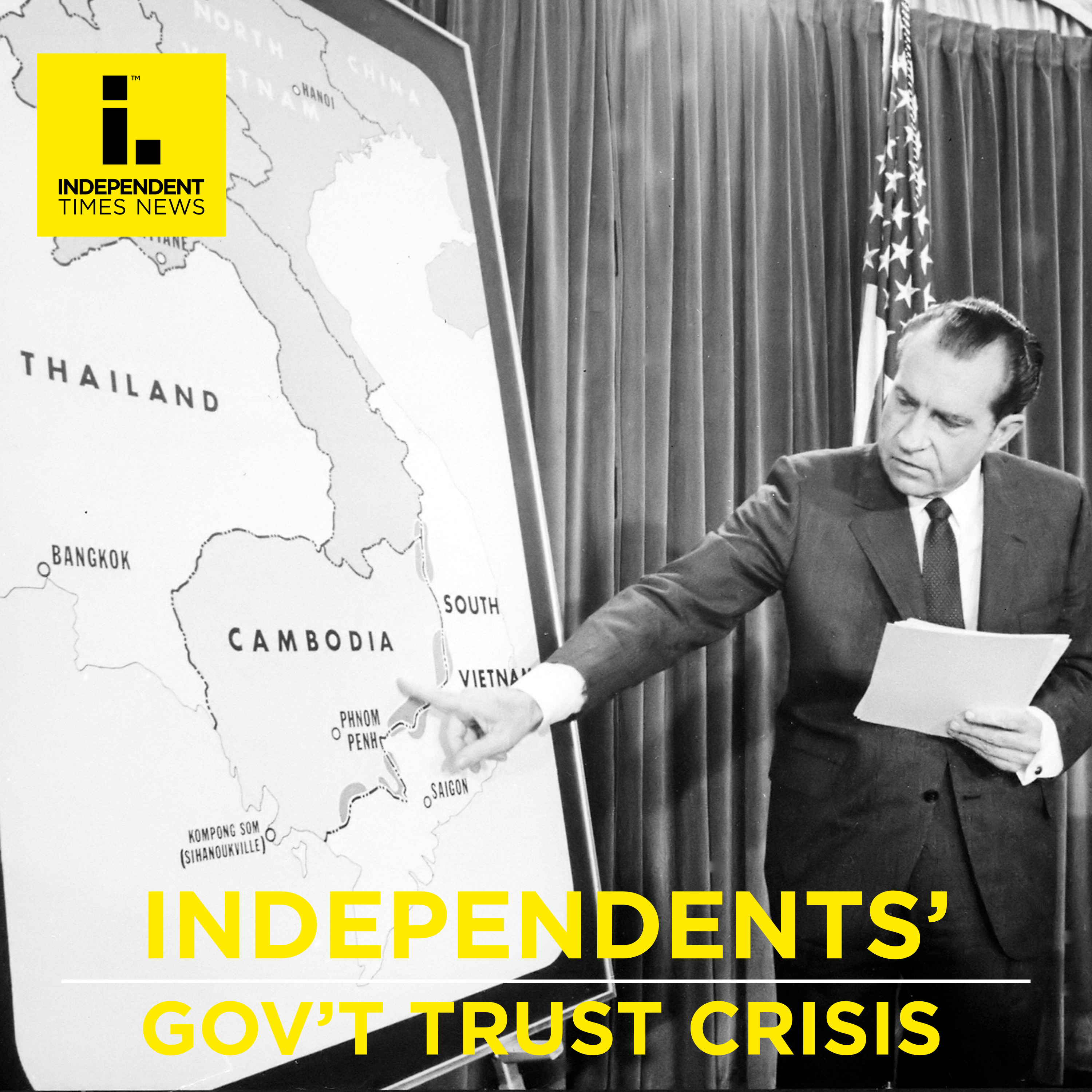
LISA: That debate about the size and role of government in our personal lives and businesses is crucial, but it's only part of the story. The other, I would argue, and perhaps more damaging, part is when the government betrays the public's trust. It’s one thing to disagree on policy; it’s so much worse to discover that our leaders have acted in bad faith and lied to us.
LEYLA: We see it all the time. We've seen it in the lies of the Vietnam War and the deceit of Watergate: the Iran-Contra situation, the justifications for the Iraq and Afghanistan wars. When the government is not honest, it becomes tough to trust.
LISA: Honestly, both parties have spent years breaking promises and gridlocking Washington, so no wonder people don’t trust a word out of D.C. Add a justice system that keeps letting the powerful skate, and the same elites who got trillion-dollar bailouts in 2008 while families lost their homes… yeah, the resentment makes perfect sense. Here’s 60 Minutes laying out exactly how Wall Street got rescued and Main Street got crushed back in 2008
[Clip: 60 Minutes Montage – The 2008 Banking Crisis and the Bailouts]
(plays)
BRYAN: Wow. That’s a long list of betrayals.
LISA: Here's the good news: Independent voters are the hope we need to force the two parties to appeal to the vast majority in America and not just the extremes in their parties. We have to amplify our voices to ensure we are seen and heard by politicians.
LEYLA: It almost sounds impossible.
LISA: It’s difficult, but I don’t think it’s impossible.
BRYAN: Okay, well, it's a serious problem. And this helps explain why roughly half of Americans are now registering as independent voters. They're fed up with the political infighting.
LISA: Definitely, independent voters are fed up with the political infighting, and the polls show it.
LEYLA: You know, it sounds dire, but there is definitely a role for us as citizens to play in this. What can our listeners do, do you think, to help restore trust in the government?
BRYAN: It starts locally. Attend town hall meetings, write letters to your representatives, and volunteer in your community. When you get involved, you see how government works firsthand, and that’s a powerful antidote to cynicism.
LISA: Also, not super exciting, but make sure you are registered to vote, mark your calendar now for upcoming local, state, and federal elections you can participate in. Make voting a priority now so you are prepared when the time comes.
LEYLA: And I have to add this, it is so imperative that you stay informed! We talked last week about how to find reliable news sources. A well-informed citizenry is essential to a republic functioning as the Founders intended. You have to be proactive today.
LISA: So it's easy to see why Churchill called democracy the "worst form except all the others." It's flawed, frustrating, and full of hard truths. But here's where we reclaim some ground: rebuilding trust, I think, starts with us, the independents in the middle, refusing to let extremes define the conversation.
It reminds me of a story from Abraham Lincoln during the Civil War, when tensions were as raw as they get. A cabinet member urged him to oust a general he openly disliked, but Lincoln paused and said, "I do not like that man. I must get to know him better." He wasn't excusing flaws; he was owning his own biases, insisting that empathy and understanding were the only way to forge unity from division. In a time of national fracture, that mindset turned opponents into allies and helped heal a broken union. And that's the hopeful spark we need right now, and why we have chosen as our Independent Hero of the Week Braver Angels, a grassroots organization taking a stand against toxic politics. They're leading a movement to bridge the partisan divide and rebuild trust one conversation at a time. You can learn more about their brave, beautiful work at braverangels.org. Here is a clip from the organization in their own beautiful words.
[Clip: Braver Angels – “We don’t have to agree… we just have to listen”]
(plays)
LISA: Thank you, BRYAN and LEYLA. It’s important to remember that progress requires a great deal of effort, but it’s still possible.
BRYAN: Keep digging for the truth, LISA.
LEYLA: Thanks. Question everything!
LISA: Low trust threatens our democracy, but independents, you’re the key. From the Civil War to the Civil Rights movement, engaged citizens changed history. Now is your time. Vote, petition, protest peacefully, and stay engaged to hold leaders accountable. Thanks, BRYAN and LEYLA. And a big thanks to our listeners for joining our community at Independent Times, where politically homeless voters find clarity in a polarized world. You’re not alone in this journey. Until next time, please follow, like, subscribe, share, and keep charting your own path.