Episode Transcript
SEASON 1 EPISODE 2
Why Are Truly Independent Politicians So Rare?
[CLIP: TITLE SEQUENCE]
(plays)
[CLIP: Seinfeld – “What’s the Deal with Politics, Am I Right?”]
(plays)
LISA: It’s not the best of times, nor the worst, but these are undoubtedly independent times. Welcome to Independent Times, the podcast for politically homeless independent voters navigating our polarized world. I’m your host, LISA Singer, and I’m so grateful you could join us today.
We just laughed with a classic Seinfeld clip poking fun at our divided politics, but for independent voters, the struggle is real.
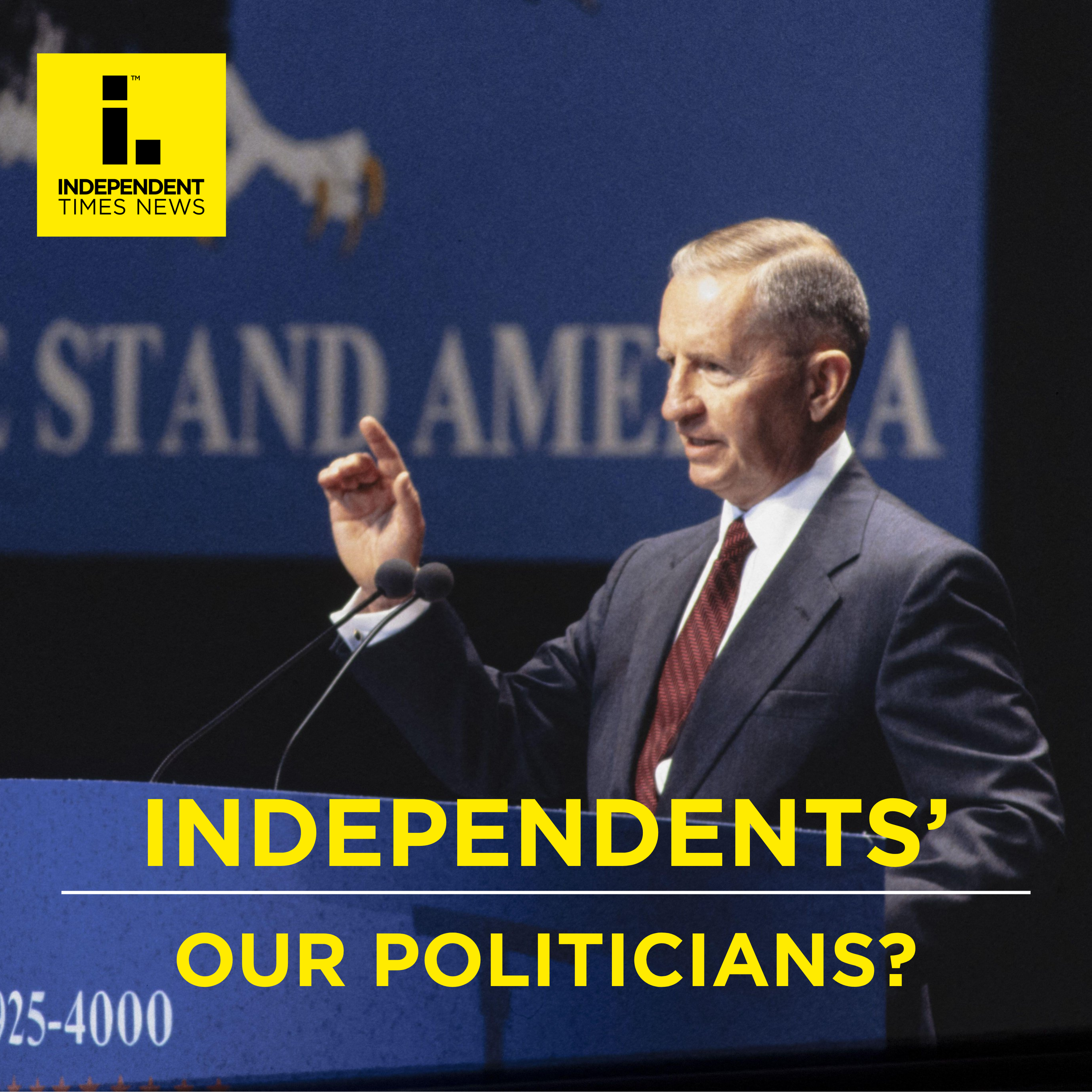
You’re America’s largest voting bloc, yet independent politicians are scarce. Today, we’ll spotlight a few—like Ross Perot and Andrew Yang—and dig into why they’re so rare and the barriers they face.
With so few independent politicians to choose from, independents—who are struggling to find representation—became the largest group of split-ticket voters in the 2024 election. This tipped critical swing states like Arizona and Michigan to Donald Trump, which showed us all once again their ability to swing an election.
Joining me are my co-hosts: award-winning journalist and host of FOX24 News Now, LEYLA Gullen, and Emmy-winning news host and producer, BRYAN Gallo. Welcome.
BRYAN: I'm Bryan Gallo, and I'm looking forward to diving into this with you, LISA. There's a lot of conversation right now about the need for independent voices.
LEYLA: And I'm Leyla Gullen. I'm thrilled to be here with you to discuss this topic. It's critical for independent voters to understand who the actual independent voices are and what they represent in our political system.
LISA: Thanks, BRYAN and LEYLA, and welcome to our listeners! When I think of independent politicians, Ross Perot is the first who comes to mind. His 1992 presidential campaign shook up the two-party system like few others have done. Let’s revisit his impact with a clip from that historic campaign.
[CLIP: “Ross Perot Announces His Presidential Bid”]
(plays)
LISA: That 1992 clip shows how an independent like Ross Perot can disrupt the status quo of the two party system. However, the polling data shows voters want more than third-party spoilers like Ralph Nader, whose run tipped Florida’s tight race in the 2000 presidential election. Yet, with 43% of Americans now identifying as independent it seems imbalances how few independent candidates are so rare in our electoral system? So, what barriers hold independents back in our polarized system, and can they make a real difference? So let’s survey the playing field next. BRYAN, LEYLA, who comes to mind when you hear “independent politician”?
LEYLA: When I think of an independent politician I definitely think of Ross Perot but I also think about the longest serving independent elected official in America, Senator Bernie Sanders from Vermont who said he wanted to spark a political revolution when he ran for President on the Democratic ticket and lost to Hillary Clinton in 2016.
LISA: Here’s Bernie Sanders in his own words, calling for a political revolution.
[CLIP: “Bernie Sanders Repeats We Need a Political Revolution”]
(plays)
LEYLA: Although Sanders is officially an independent, he caucuses with the Democrats and usually votes with Democratic Senators along party lines. I recently saw Senator Sanders on Joe Rogan, along with 5 million other Americans, and they discussed, among other things, climate change, President Trump suing the free press, and also the need to raise the minimum wage:
LISA: I remember that episode. That was a great interview, and I heard it was one of Rogan’s most-watched episodes ever. Let’s go ahead and play a clip on what Rogan and Sanders discussed about the minimum wage.
[CLIP: “Bernie Sanders on The Joe Rogan Podcast Discussing Minimum Wage”]
(plays)
LEYLA: When it comes to Independent Politicians, I also think about the only other independent Senator, Angus King. He was elected as an independent from Maine and typically caucuses with the Democrats as well. I once heard him say that being independent is part of the culture in the state of Maine, which I found interesting:
LISA: Sounds like we need to interview Independent Senator King. I remember when Paul Rieckhoff interviewed the Senator on the podcast called The Independent American. Let’s play a bit of that discussion on the heritage in Maine.
[CLIP: “Angus King on The Independent Americans Podcast - Maine’s Virtues”]
(plays)
LISA: Here’s a wild stat: Out of 7,386 state legislative seats nationwide, only 25 are held by independents! And In the U.S. house of representatives House? Zero independents elected officials.
BRYAN, who comes to mind when I say ‘independent politician’ or ‘candidate’?
BRYAN: When I think about independent politicians, I think of Andrew Yang, who campaigned in 2020 with the concept of Universal Basic Income, which I found to be a fascinating idea and who couldn’t benefit from a little extra monthly cash:
LISA: That would be nice, especially now. So let’s have a listen to Andrew Yang in his own words, making the case for Universal Basic Income, it’s controversial for sure – Major Garrott interviewed him on The Takeout Podcast, let’s have a listen to what he said back in 2020:
That would be nice, especially now. I recall when Andrew Yang spoke with Major Garror on The Takeout Podcast. Let’s play a clip of Andrew making a case for Universal Basic Income back in 2020:
[CLIP: “Andrew Yang on The Takeout Podcast – Universal Basic Income”]
(plays)
BRYAN: After his failed 2020 presidential campaign, Yang also ran for Mayor of New York City in 2021 as a Democrat. He later announced his departure from the Democratic Party to become an independent and subsequently founded the Forward Party, a centrist political party aimed at offering an alternative to the two major parties. They have already gotten around a dozen people elected to local office. All politics is local, right?
LISA: Right, exactly. Tip O’Neill famously said that, and that still holds for many independent voters. Let’s go ahead and play a clip of Andrew Yang explaining his vision for the Forward Party during his appearance on Good Morning America back in 2020.
[CLIP: “ Andrew Yang Interviewed on Good Morning America – The Forward Party”]
(plays)
BRYAN: However, I also agree with LEYLA that Ross Perot comes to mind first and foremost. Beyond him, though, I find it really fascinating – and perhaps a little troubling for some – how politicians can just switch parties, like we saw with Joe Manchin and Kyrsten Sinema. While both left the Senate and didn't run in 2024, their decisions to become independents highlight an odd aspect of political party affiliation.
LISA: Agreed, you’ve raised a vital point about our electoral system. We have "sore loser" laws in the U.S. that aim to prevent candidates who lose a party primary from running again in the same election under a different party banner. A prime example is Joe Lieberman, a lifelong Democrat who lost the 2006 Connecticut Democratic Senate primary to Ned Lamont, but then ran as an independent and won his fourth Senate term. We’re seeing a similar dynamic in New York’s mayoral race, where former Governor Andrew Cuomo and Mayor Eric Adams are now running as independents. Go figure.
LISA: So, let’s take a moment to review how this played out recently. Here’s a quick montage I put together from the 2025 NYC mayoral race, where Cuomo and Adams both explain why they switched parties after losing the Democratic primary.
[CLIP: “2025 NYC Mayoral Race – Cuomo and Adams Run as Independents”]
(plays)
LEYLA: Well, maybe our country can’t handle more than 2 parties, and that is the issue. Is it in the Constitution that we are a two-party system?
LISA: The short answer is that the Constitution doesn't specify the number of political parties we can have. Instead, it's left up to each state to run its own elections, which is why voting in America can be so complicated, as every state has its own set of rules. It’s very challenging for the 9 million Americans who live abroad, as well as those serving in the armed services. Consider this: if you have to move from state to state, you can miss those registration windows.
BRYAN: Let me jump in because I need some clarity. So, there have only been a few political parties in this country?
LISA: There are two main parties, the Democrats and Republicans. Actually, there have been hundreds of 3rd parties over the course of U.S. history. But only a few dozen have won seats or made an impact like the Populist Party, the Progressive Party, the Socialist Party, the Prohibition Party, the American Independent Party not to be confused with independent voters we are talking about this one was founded by George Wallace the former governor of Alabama who supported segregation please Californians don’t check that box to vote, the Reform Party founded by Ross Perot also is still around, and currently active ones like the Libertarian, Green, and Constitution Parties. According to Ballotpedia, there are presently 50 active political parties in the United States.
LEYLA: Wow, that’s Amazing. I love Balotpedia. You really never hear about those other parties except Republicans, Democrats, and Independents.
BRYAN: Right, right, right. I heard about the Green Party, and Jill Stein was on that ticket. Where is she now? Never mind. You know, never mind that.
LEYLA: Steve Kornacki said that ultimately, independents vote for one party or another:
LISA: That’s true, but it’s a bit more complicated than that. Let’s listen to Steve Kornacki break down how independents end up voting.
[CLIP: “Steve Kornacki Explains How Independent Voters Vote”]
(plays)
BRYAN: That’s because they have no choice. We are not given any options except democratic or republican candidates. Once in a while, a 3rd party candidate, or more often than not, someone like RFK Jr., who lost the democratic primary but then switched to independent, and then you don’t know who they really are or what they stand for when they flip-flop parties.
LISA: Voters do not like a flip-flopper for sure. Let’s have a listen to RFK Jr. on the 2024 campaign trail after he lost the Democratic primary:
[CLIP: “RFK Jr. Explains Why He Is Running as an Independent”]
(plays)
LISA: Imagine if you're a voter who voted for that person, you thought they were going to be a Democrat or Republican, and then they switch to one or the other, independent. It's very, very frustrating.
BRYAN: Wow, okay. Well, I did a little research on my own, and here is what I found independent voters telling us. And they all seem similar with this feeling that no one is fully representing them on all the issues that they actually care about.
LISA: Here’s what unaffiliated independent voters are actually saying — in their own words.
[CLIP: “Montage Of Independent Voters In Their Own Words”]
(plays)
LEYLA: Okay, that last independent voter said that independents don't want to vote for the least worst candidate. how do independent voters know who to vote for rather than just finding the lesser of the evils?
LISA: I'm with you—so many people are fed up with just having to choose between the 'lesser evil.' But finding a real independent candidate feels almost impossible, right? Kramer asked what’s the deal with politics so I have to ask, what's the deal with that? The truth is, the political system makes it incredibly difficult for them to even get started. I'm talking about things like confusing ballot rules, lack of funding, and a whole election process designed by for the two major parties who have been around since the Civil War. The good news is, there are some ideas floating around to fix this.
LISA: So let’s take a moment to review some of the reform ideas for independent voters. I put together a montage of the best ideas for political change I have heard so far, they’re all doable and all will have a significant impact if they can be implemented, and we’re here to help:
[CLIP: “Montage of Ideas How To Reform Politics for Independent Voters”]
(plays)
LISA: That video showed us just how hard it is for independents, but it's not hopeless. That's why Andrew Yang is our Independent Hero of the Week.
You may recall him from his 2020 run, but now he's focused on reforming the system itself with the Forward Party. He's fighting for reforms like ranked-choice voting and open primaries—changes that have already helped independent candidates get elected in places like Maine.
It's all about giving voters more than two choices and breaking the political gridlock. Here's a clip from his TED Talk on his vision
[CLIP: “Andrew Yang on 2024 TED Talk Why US politics is broken — and how to fix it”]
(plays)
LISA: Thanks BRYAN and LEYLA. That was a fantastic discussion today! Thank you to our listeners for joining our community at Independent Times, where politically homeless voters like you find clarity in a polarized world. You’re not alone in this journey.
Next time, we’re diving into the real battle for accountability. We'll explore the ongoing fight as the free press tries to hold our politicians accountable, examining the high-stakes wins and the sobering losses. It’s a story with real ups and downs, real consequences for our country, and you won’t want to miss it. Until then, please take a moment to follow, like, subscribe, share, and keep charting your own path.