Episode Transcript
SEASON 1 EPISODE 1
How independent voters became the new majority
[CLIP: “TITLE SEQUENCE”] plays
[CLIP: “Family Guy Skewers Swing Voter Absurdity”] plays
LISA: It’s not the best of times, nor the worst, but these are undoubtedly independent times.
Welcome to Independent Times, the podcast for politically homeless independent voters navigating our polarized world. I’m your host, Lisa Singer, and I’m so grateful you could join us today.
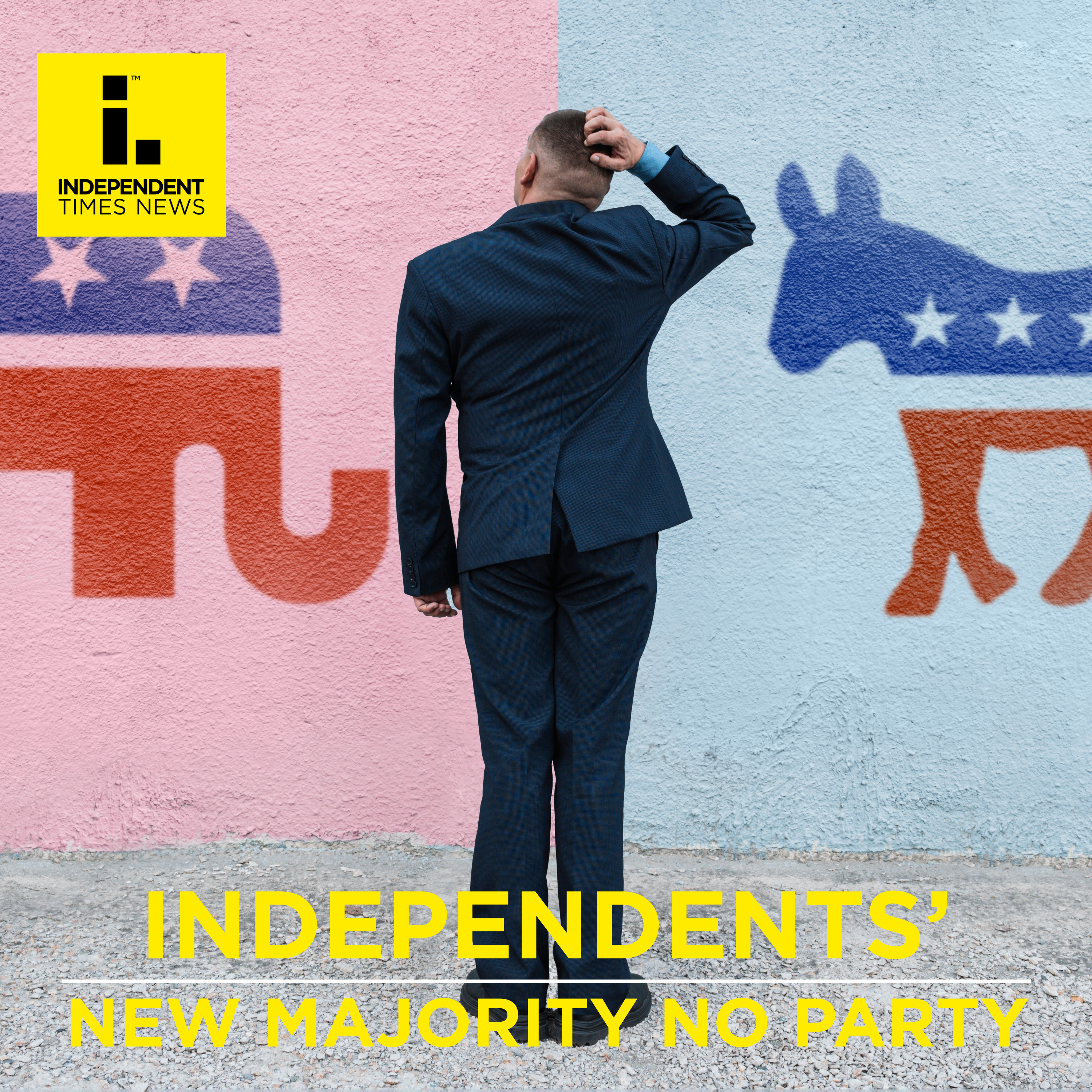
We just heard Brian Griffin’s quip about independent voters being wishy-washy, but the reality is far from that stereotype. For the first time ever, 43% of Americans identify as independent, dwarfing the 27% for each of the Democrats and Republicans.
Who are these voters, what drives them, and how are they reshaping our politics?
Today, we’ll unpack their power and purpose in a divided nation.
Joining me are my co-hosts: award-winning journalist and host of FOX24 News Now, Leyla Gullen, and Emmy-winning news host and producer, Bryan Gallo. Welcome.
LEYLA: I'm Leyla Gullen, and I'm excited to be here with you, Lisa, to explore what it means to be America's largest and fastest-growing voting bloc. This is a conversation about power and its use.
BRYAN: And I'm Bryan Gallo. I'm glad to join you, Lisa. When you examine the numbers, it's clear that the future of this country lies in independence.
LISA: First, let’s look at the numbers. Here’s a quick montage of just how big the independent bloc has become.
[CLIP: “INDEPENDENTS BY THE NUMBERS MONTAGE”] plays
LEYLA: Wow, that’s amazing
BRYAN: Is this new what is going on with almost half the country right now registering or identifying as independent?
LISA: Based on polling data, only 20% of Americans identified as independents in 1950. That number grew to 33% by 1988, and today, Gallup polls show independents make up a staggering 43% of registered voters. With Republicans and Democrats each hovering around 27%, this shift signals a profound and growing impact on our country’s political landscape. Independents aren’t just growing, they’re a political force. Here’s the montage of video clips I put together on what the data says.
[CLIP: “INDEPENDENTS ARE A FORCE MONTAGE”] plays
BRYAN: So, independents are saying they are frustrated with both the Republicans and Democrats and want to focus on the issues rather than being bound to the parties. So, what are independent voters, and what do they actually want?
LISA: Honestly, when you try to define independents using those traditional political methods—by looking at demographics like race, income, education, or gender—it just doesn't work very well. You'll find them represented in every group across the country.
What truly defines them isn't their demographics, but their motivation. They're making a very conscious choice to reject a political system they see as broken. They're basically telling the two parties, "We don't want your labels. We want to move past the division that has defined our politics. We want bipartisan solutions and civil discourse, and we're willing to support candidates who are focused on the issues we care about more than just their political party's wins."
And they've shown that they can truly swing an election one way, and if they don't like how things are going two years later, they're not afraid to swing it right back in favor of the other party.
Their growing numbers really reflect a fundamental problem: that neither the Republican nor the Democratic party platform fully represents what a large portion of the country is looking for.
BRYAN: Okay, okay, but misunderstood sectarianism, overthrowing traditional categories, none of this sounds good or healthy.
LISA: Well, the studies show that independents have a low trust in our government. Trust in government is down nationwide, but it's shallow among individuals who identify themselves as independents.
LEYLA: So you've laid out a really great history on independent voters. So, how do we exactly define independent voters? Is there a short answer? If someone were to ask me, what is an independent voter? How should I answer that?
LISA: That’s a great question. And to answer that, here’s a montage of video clips I put together from voters and experts to help us better understand who is an independent voter.
[CLIP: “WHO ARE INDEPENDENTS MONTAGE”] plays
LISA: Independents are unpredictable in their voting behavior. in, I'll just give you a few examples. In 2008, they backed President Obama by eight points. Then they backed Trump by four points in 2016. Then in 2020, they backed Biden by 13 points. And the results are kind of mixed in 2024. I'm still studying the data as is everybody, but
In 2024, they wound up being the largest group to split their tickets and vote for one party for the White House and another party for Senate or Congress. And I'm sure you saw the exit polls, and this was talked about a lot on TV, that New Yorkers said that they voted for AOC as their House representative, but then they voted for Trump as president.
To show just how often independents split their tickets, here’s a montage of video clips I put together from the latest election data.
[CLIP: “INDEPENDENTS ARE SPLIT TICKET VOTERS MONTAGE”] plays
LEYLA: So, how do independent voters know who to vote for rather than just finding the lesser of the evils?
LISA: That's why we're here. That's why the three of us are here to help independent voters sort through the issues they care about most, to break down and debate the headlines from as many angles and perspectives as possible, with as much context as we can.
BRYAN: Okay, Lisa, with all due respect, you know I love you, but you make it sound so simple, right? We know that with independents getting locked out of 22 state primaries for president, which means 23 million independents can't vote in the primaries, and then probably check out from politics altogether. I mean, I would too. You don't want me? Well then, I mean, bye, right?
LEYLA: Yeah, yeah. Well, it's no wonder over 80 million Americans did not show up to vote in 2024. You know, voting is a lot harder in this country than people think.
LISA: It definitely is hard to vote in America. And that's why we're here. We're going to help provide everyone with the information and tools they need. To make following the news and voting easier. At the end of each show, we're going to pick our independent hero of the week and profile some great overlooked American people and stories. We're going to try to highlight as many hero stories as we can, and we always want to end on a hopeful note. There's a lot of bad news, but one of the things I absolutely love about living in America is that for everything bad going on, for every issue and problem and pain that there is, there's always someone in America who's working to solve it, to make it better. And that gives me a great deal of hope and strength.
LEYLA: Yeah, absolutely.
LISA: Well, we still have a lot to talk about when it comes to independent voters: who they are, what they want from their elected representatives, and we're going to tackle the news from their perspective, one issue at a time, every week.
But right now, we can find comfort in the fact that independent voters have a real opportunity to bring this country together and help it heal. Our Independent Hero of the Week, Jackie Salit, has explained this better than anyone. As the author of Independents Rising, here's what she had to say about the power of independents to drive change...
[CLIP: “DR. SALIT SAYS INDEPENDENTS BRING PEOPLE TOGETHER”] plays
LISA: What a fantastic discussion today! Thank you, Bryan and Leyla. Thank you to our listeners for joining our community at Independent Times, where politically homeless voters like you find clarity in a polarized world. You’re not alone in this journey.
Next time, we’ll explore independent politicians, from trailblazers like Ross Perot and Andrew Yang to the independents running in the upcoming mayoral race in New York . You won’t want to miss it. Until then, please take a moment to follow, like, subscribe, share, and keep charting your own path.