Episode Transcript
Part 2: Mail-In Voting From The Civil War to SAVE
INTRO LISA SINGER
From the Independent Times Newsroom, this is an audio edition of our latest report.
Published on April 14th 2026. Narrated for you to take the news on the go.
I’m Lisa Singer, Editor-in-Chief of Independent Times News. Thank you for joining us.
In Part 1, we examined the history and the political standoff in the Senate over the SAVE America Act.
Today, we examine one of the most contentious parts of the bill: mail-in ballots. While this has become a modern flashpoint, its roots in American history go back to the Civil War.
Republicans argue that the current system has outpaced its original intent, stating that 'the lack of uniform standards across state lines creates a patchwork of vulnerability.'
Meanwhile, critics of the SAVE America Act argue that the bill’s new restrictions threaten a tradition of critical access for millions of Americans. They contend the bill could disenfranchise voters who rely on the mail, including the elderly, the military, and those living abroad.
So, how did we get from soldiers voting during the Civil War to the current debate over mail-in ballots?
Today, Leyla Gulen joins us to narrate Part 2 of our series: Mail-In Voting From The Civil War to the SAVE America Act.
NARRATED BY LEYLA GULEN
In the heat of the 1864 presidential election, the United States was a nation at a breaking point. The Civil War had entered its fourth devastating year. President Abraham Lincoln faced not only the Confederacy but a fierce re-election challenge against General George B. McClellan. War weariness was widespread, casualties were staggering, and many feared the Union itself might not survive. Some Democrats argued that holding a national election amid rebellion was too dangerous and should be postponed.
Lincoln refused. He insisted that democracy must continue even in wartime. In a letter to General William Tecumseh Sherman, he wrote: "We cannot have free government without elections; and if the rebellion could force us to forego, or postpone a national election, it might fairly claim to have already conquered and ruined us."
To ensure Union soldiers could still participate, Lincoln pushed states to allow troops to vote by mail from their camps and battlefields. This wartime emergency measure marked the birth of organized mail-in voting in America, not out of convenience but out of necessity.
After the Civil War, mail-in voting slowly transformed from a wartime workaround into a routine part of American life:
• In 1896, Vermont became the first state to allow civilian absentee voting, though voters had to prove they were physically ill or traveling.
• In 1944 and during WWII, the Soldier Voting Act showed the postal system could securely handle high volumes of ballots sent across oceans, standardizing the process for millions of troops.
• In 1978, California became the first state to allow no-excuse absentee voting. For the first time, voters could choose mail-in simply because it was more convenient.
• Between 1998 and 2014, Oregon, Washington, and Colorado moved to universal mail-in Voting, where every active registered voter automatically receives a ballot by mail.
• During the 2020 COVID pandemic, states were prompted to implement a massive nationwide expansion of mail-in voting through temporary emergency orders.
• 2021–2025: By 2025, 36 states and the District of Columbia had officially codified no-excuse absentee voting into state law. The remaining 14 states require voters to provide a specific, state-approved reason to receive a mail-in ballot.
For decades, both parties viewed absentee Voting as a nonpartisan utility and strongly encouraged its use by military families and seniors. However, following the 2020 election, the political landscape underwent a fundamental shift in polarity. We can trace this evolution through President Trump’s public statements:
Between 2016 and 2019, Trump and Republicans generally treated traditional absentee voting as acceptable and even encouraged it in key states. He did not yet frame expanded mail-in Voting as a major threat.
But then, in 2020, as states dramatically expanded mail-in Voting during the pandemic, Trump’s rhetoric sharpened. He repeatedly called expanded mail-in voting a “disaster” and warned of widespread fraud.
On July 10, 2020, he tweeted: “Absentee Ballots are fine because you have to go through a precise process to get your voting privilege. Not so with Mail-Ins. Rigged Election!!! 20% fraudulent ballots? ... Mail-In Ballot fraud found in many elections. People are just now seeing how bad, dishonest, and slow it is. Election results could be delayed for months. … Just a formula for RIGGING an Election….”
By 2026, President Trump moved from criticism to policy action, and in March 2026, while advancing the SAVE America Act, he stated: “The cheating on mail-in Voting is legendary. It’s horrible. We’re going to stop it because it’s corrupt.”
The partisan gap in voting methods has become a defining feature of elections. In 2020, about 60 percent of Democrats voted by mail compared to just 32 percent of Republicans. By 2026, polling shows 84 percent of Democrats favor expanding mail-in access, while Republican support has fallen to 38 percent.
For many Independent voters, the debate is not about partisan advantage. It is a practical trade-off between convenience and verifiable security. As we examine current protocols, one key question emerges: Does the proposed SAVE America Act provide necessary safeguards, or does it create new barriers for the roughly 30 percent of Americans who now rely on mail ballots?
What does Mail-In Voting look like Today?
In the 2024 election, nearly 30 percent of all voters, roughly 48 million ballots, were cast by mail. Seniors (65 and older) continue to rely on it heavily, with nearly 37 percent choosing the mailbox.
The process depends on each state’s voter registration database. Voters are verified against the rolls to confirm eligibility and prevent double Voting. Ballots can be returned by U.S. mail or dropped off at designated drop box locations. They are tracked using sophisticated ballot-tracking systems that follow the lifecycle of the physical ballot envelope from start to finish. While the vast majority of mail ballots are legitimate, fraud concerns persist.
The Heritage Foundation’s Election Fraud Database has documented 289 cases involving fraudulent use of absentee or mail ballots since 1982.
Proponents of the SAVE Act argue that even rare instances can erode public trust in the system. Republican leaders have pointed to several high-profile cases to support their concerns, including:
• A 2022 ballot harvesting scheme in Bridgeport, Connecticut, in which individuals were convicted of collecting and submitting fraudulent absentee ballots.
• They also found multiple instances in North Carolina’s 9th Congressional District in 2018, where a Republican operative and associates were charged with illegally collecting and altering absentee ballots.
• Additionally, there have been cases in Pennsylvania and Georgia in which ballots were cast in the names of deceased voters or with outdated addresses.
Now, let’s examine the key differences between mailing ballots through the U.S. Postal Service versus using secure ballot drop boxes.
Following a razor-thin 2004 gubernatorial election in Washington state, one of the closest in U.S. history, election officials realized that relying 100 percent on a third-party carrier like the USPS created a single point of failure. In 2005, Washington began installing dedicated boxes aggressively. The goal was not just convenience; it was to provide a fail-safe that allowed a ballot to go directly from the voter's hand into the legal custody of the county auditor, bypassing the variables of postal sorting and postmark delays.
What started as a regional solution eventually became a federal engineering standard. The Election Assistance Commission (EAC) stepped in to define what a drop box actually is. Unlike a standard blue mailbox, a certified ballot drop box is built like a safe with heavy-gauge steel, anti-tampering slots, and it is bolted to the concrete to prevent theft.
The Post Office has a massive network, so why build a separate one? It comes down to the chain of custody and timestamps. A ballot in a blue USPS box travels through multiple regional sorting facilities and is handled by numerous employees. A drop box is a closed-loop system; only bipartisan teams of election officials have the keys.
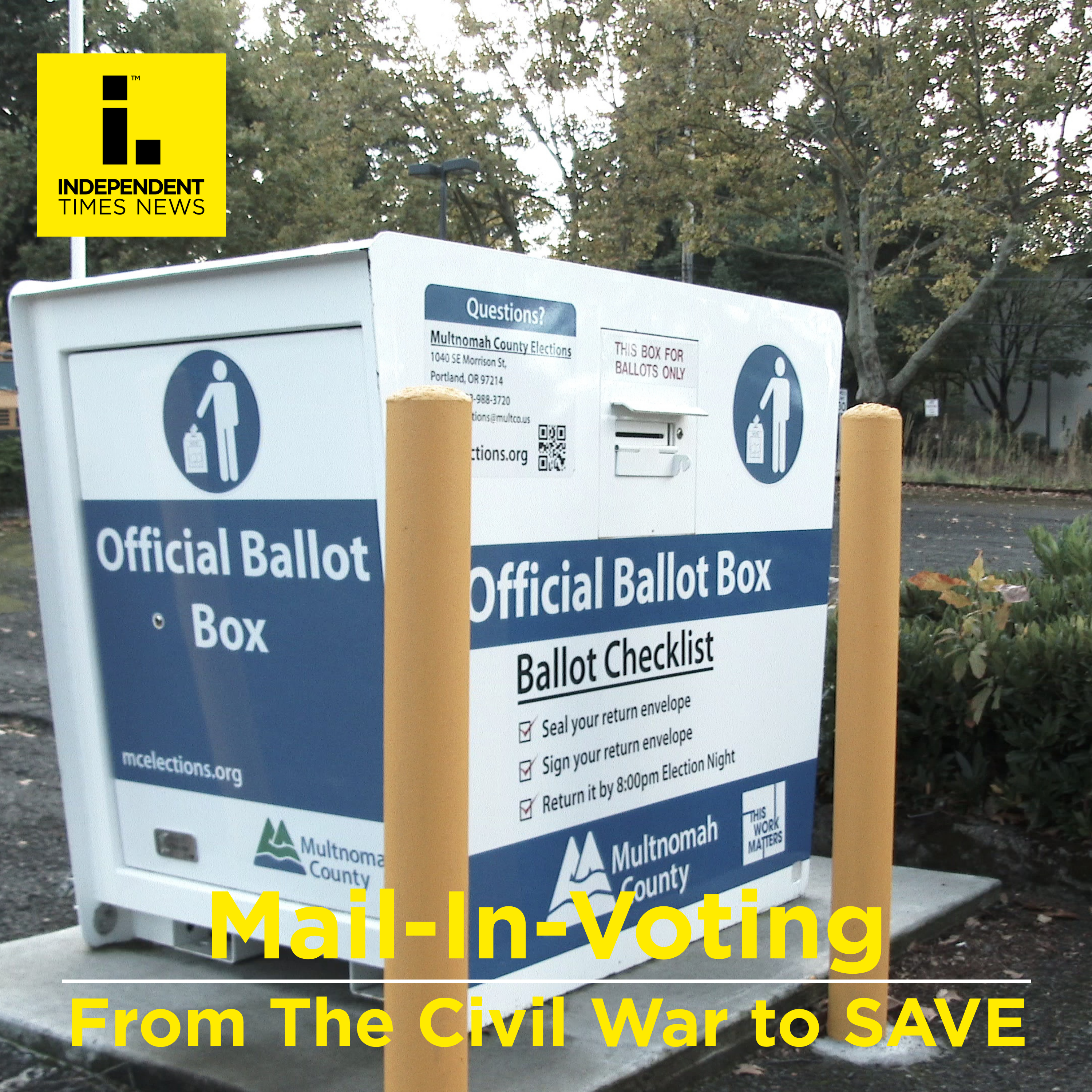
A drop box has a hard deadline: at 8:00 PM on Election Day, an official locks the slot. There is no ambiguity about whether the ballot was on time. Modern drop boxes are typically located in high-visibility, well-lit areas, such as in front of City Hall, county courthouses, or libraries. They are increasingly required to have 24/7 high-definition video surveillance.
This brings us to an important question: How are mail-in ballots tracked?
As of 2026, 47 states and the District of Columbia have adopted sophisticated ballot-tracking systems for both mail-in ballots sent through the Post Office and drop box locations. Much like a high-end courier service, these systems provide voters with text or email notifications at three critical intervals: when the ballot is mailed, when the election office receives it, and when it is successfully processed. This digital handshake was designed to build trust, ensuring that a ballot does not simply vanish into a black hole once it leaves the voter's hand.
However, digital trust was tested by physical violence in late 2024. In the weeks leading up to the presidential election, unknown suspects targeted ballot drop boxes in Portland, Oregon, and Vancouver, Washington, with sophisticated handmade incendiary devices containing thermite, a mixture capable of burning at temperatures as high as 4,000°F.
In Portland, the box’s internal fire-suppression system worked as designed and limited the damage to just a few ballots. In Vancouver, the system failed, destroying or damaging hundreds of ballots and forcing election officials to identify and re-issue replacement ballots for affected voters. The FBI continues to investigate the attacks as linked incidents. As of early 2026, no arrests have been made, and the bureau is offering a $25,000 reward for information leading to the suspect.
In response to the 2024 attacks, many states strengthened security requirements for ballot drop boxes. While 29 states still officially permit or require them, 26 have introduced stricter physical security standards. These boxes must now be bolted to the ground, equipped with fire-suppression systems, and monitored by 24/7 high-definition surveillance.
At the same time, states have taken very different approaches to the number of drop boxes they allow. California continues to require at least one box for every 30,000 registered voters. Other states have moved toward much greater consolidation. Texas, for example, now limits each county to just one official drop-off location. In Harris County, home to nearly 4.8 million people, this has resulted in a single drop box serving the entire county. For many voters, this effectively pushes them back toward the U.S. Postal Service, the very system now facing new logistical challenges from the 2026 postmark delays.
Next, we’re going to dig into why deadlines have suddenly become so much more important with mail-in voting.
In January 2026, the U.S. Postal Service changed how it applies postmarks. A postmark now reflects the date the ballot is processed at a regional sorting hub, not the day it was dropped in your local mailbox.
This change matters most in the 14 states (and D.C.) that allow ballots to be counted if they are postmarked by Election Day. Because the official postmark is now later, a ballot mailed on time could receive a postmark dated after Election Day and be rejected.
Under the leadership of Postmaster General David Steiner, who succeeded Louis DeJoy in 2025, the USPS has described the postmark change as a mechanical and cost-saving necessity within its ten-year “Delivering for America” plan.
In a January 2026 letter to Steiner, Congressman Gabe Vasquez warned that this centralization “risks leaving rural America behind,” noting that “a ballot dropped in a rural mailbox on Monday may not reach a regional hub for its automated timestamp until Wednesday, potentially missing strict legal deadlines.”
While most voters are focused on domestic mail-in deadlines, there’s an entirely different system for those serving our country abroad. Let’s turn now to the Military and Overseas Voting System.
Roughly 1.3 million active-duty personnel and 9 million Americans living abroad manage their voting through the Federal Voting Assistance Program. This office provides a specialized, streamlined process for those serving in the military or living outside the U.S.
They use the Federal Post Card Application, a single form that handles registration, address updates, and ballot requests. Voters affirm citizenship under penalty of perjury without attaching documents.
Federal law requires states to send ballots at least 45 days before Election Day to allow for international mail delays. If the regular ballot does not arrive in time, voters can use the Federal Write-In Absentee Ballot (FWAB) as a backup.
After passing the House in February 2026, the SAVE America Act faced a significant setback in the Senate on April 23, 2026, when an amendment to advance the bill was defeated. While it remains a top legislative priority for proponents, it is currently stalled in the Senate.
If the bill eventually becomes law, here is how it would change off-site voting:
All first-time voter registrants must provide documentary proof of U.S. citizenship. Valid documents include a U.S. passport, a certified birth certificate, or approved military or naturalization documents. Notably, standard driver’s licenses and even most REAL IDs would no longer satisfy this registration requirement on their own.
If you are already registered and your information remains exactly the same, you do not need to provide new proof of citizenship to stay on the rolls.
Any change to your registration, including a change of address, a name change (marriage or legal), or a party switch, would trigger a requirement to provide documentary proof of citizenship before the update is finalized.
But the most critical technical shift for current voters states that regardless of how long you have been registered, every person using an off-site method (be it mail-in, drop box, military, or overseas) must include the following inside their return envelope:
• A physical photocopy of a valid government-issued photo ID. Valid Photo IDs for this step include: U.S. passport, driver’s license, state-issued ID, military ID, or tribal ID.
• But if a voter is unable to provide a photocopy after reasonable effort, they may instead provide the last four digits of their Social Security Number along with a signed affidavit attesting to their citizenship and identity.
The Act also mandates a strict Election Day receipt deadline, effectively ending the "postmark grace periods" used by many states. Additionally, it requires ongoing cross-checking of all voter rolls against federal DHS and Social Security databases to verify citizenship status.
Critics of the Act argue that the new "verification locks" are a solution in search of a problem. Democratic Senator Alex Padilla of California (D-CA), challenged the premise of the bill in March 2026, stating: “Noncitizens voting is already a felony, and it's exceedingly, exceedingly rare... we should be working to make it more accessible for eligible Americans, not harder.”
Democratic Representative Terri Sewell of Alabama, who is a lead advocate for voting rights, further sharpened the critique during the February 2026 House debate, labeling the bill an "election takeover" and noting: “The so-called ‘SAVE America Act’ would block millions of eligible American citizens from Voting... Republicans know that they cannot win on the merits, so rather than changing their policies, they are seeking to change the rules.”
Democratic Senator Richard Blumenthal of Connecticut led this line of critique on the Senate floor in March 2026, arguing that the bill would "shred" active-duty service members' ability to participate. He pointed out the irony of the new receipt deadlines, noting that the very same military ballots being targeted now were the ones that "decided the 2000 election."
We must now ask whether there is a Path Forward?
If 1864 taught us that the ballot is the only way to sustain a free government, 2026 is asking: At what point do the new security locks start locking out the very voters the system was designed to protect? To answer that, we have to look at how states try to clean the lists without deleting you. Join us for Part 3 of our voting series, where we dig into the balance between accurate rolls and voter protection.
In the meantime, please take note that the most effective way to ensure the mail-in system is working for you is to monitor your ballot's progress in real time. Just as you would track a critical package, you can use official state tools to see when your ballot is mailed, received, and successfully counted.
You can find the specific tracking tool for your state by visiting Vote.org's Ballot Tracker. Taking a few minutes to audit your ballot’s journey provides the ultimate clarity in an era of complex system updates.
OUTRO LISA SINGER
That was Leyla Gulen narrating for Independent Times News. For more news and action built for independents, head to IndTimes.news. These may not be the best of times, nor the worst, but these are undoubtedly independent times. I’m Lisa Singer. Thank you for listening, and please remember your voice matters.